


PepSync

BPC-157 dosage calculator

Mix a 5 mg BPC-157 vial with 2 mL of bacteriostatic water to get 2.5 mg/mL. A 250 mcg dose is then 0.1 mL, which is 10 units on a U-100 insulin syringe.

  • Free, no sign-up
  • Formula shown below
  • U-100 syringe units

BPC-157 dose calculator

Free, no CC requiredSave your doses and create schedules.Get PepSyncGet app
On the vial label
mg
Amount you add
mL
What you plan to take
Syringe sizeU-100 insulin syringe
The PepSync app

Track your BPC-157 doses in one place.

Save your peptides, mixes and schedule, and get a reminder when each dose is due.

  • Saved calculationsEvery vial and dose one tap away. No more screenshots.
  • Schedules & remindersDaily, weekly or custom. Get a nudge when it’s time.
  • Titration plansStep your dose up over weeks with the draw worked out for each step.
  • Dose logSee what you took and when, and how much is left in the vial.
“User friendly. Easy to navigate and understand.”
jusPeaches · App Store review · United States
Start tracking — it’s free4.9 on the App StoreFree to download · No CC required
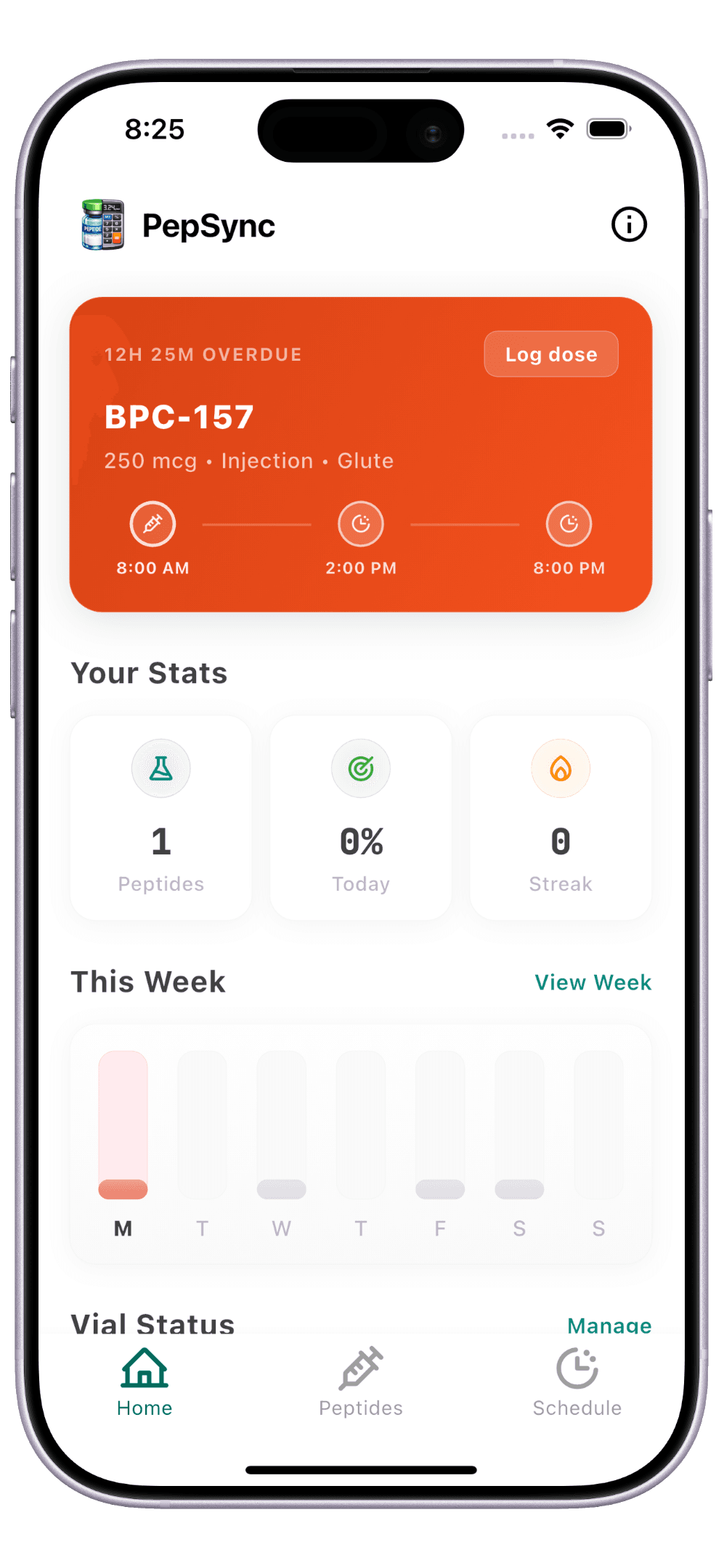
The PepSync app home screen with saved peptides and today’s doses
App Store rating
4.9
calculations run
428,000+
peptides supported
100s
Built with research from
  • World Health Organization
  • University of Oxford
  • Harvard Medical School

Built with clinicians · No data leaves your device

How your BPC-157 draw is calculated

  1. 1Find the concentration

    5 mg × 1,000 ÷ 2 mL
    = 2,500 mcg/mL

  2. 2Work out the volume

    250 mcg ÷ 2,500 mcg/mL
    = 0.10 mL

  3. 3Convert to units

    0.10 mL × 100
    = 10 units

On a U-100 insulin syringe, 100 units equals 1 mL, so each unit is 0.01 mL. The 0.3 mL (30 unit) and 0.5 mL (50 unit) syringes use the same scale, just shorter, which makes small doses easier to read.

Use this BPC-157 calculator to convert vial amount and water volume into a precise draw amount. BPC-157 is often discussed in recovery communities, but human evidence and regulatory status vary by location.

Common vial examples
5 / 10 mg
Example dose
250 mcg
Common syringe
U-100 insulin
Last reviewed
Educational reference only. Not medical advice — follow the instructions from your clinician or pharmacy.

Quick math example

A 5 mg vial mixed with 2 mL gives 2,500 mcg/mL. A 250 mcg dose is 0.1 mL, or 10 units on a U-100 syringe.

BPC-157 reconstitution reference

U-100 units to draw for each common BPC-157 dose, by vial size, reconstituted with 2 mL of bacteriostatic water. Change the water volume in the calculator above to recompute for your own setup.

VialConcentration200 mcg250 mcg500 mcg
5 mg2.5 mg/mL8 u(0.08 mL)10 u(0.1 mL)20 u(0.2 mL)
10 mg5 mg/mL4 u(0.04 mL)5 u(0.05 mL)10 u(0.1 mL)

Swipe the table to see every dose →

Educational reference only — not a dose recommendation. Units assume a U-100 insulin syringe (100 units = 1 mL on U-100). Always confirm against your own vial, diluent, and clinician or pharmacy instructions.

How the BPC-157 calculation works

BPC-157 is commonly labeled in milligrams per vial while target amounts are often discussed in micrograms. The calculator keeps those unit conversions explicit.

Once concentration is known, every dose is just target mcg divided by mcg per mL.

  • 5 mg vial = 5,000 mcg total
  • 2 mL water = 2,500 mcg per mL
  • 250 mcg target = 0.1 mL draw

BPC-157 5 mg vial with 2 mL example

A 5 mg BPC-157 vial contains 5,000 mcg. Mixed with 2 mL, that gives 2,500 mcg/mL.

A 250 mcg target dose is 0.1 mL at this concentration. On a U-100 syringe, 0.1 mL equals 10 units.

  • 5 mg = 5,000 mcg
  • 5,000 mcg / 2 mL = 2,500 mcg/mL
  • 250 mcg / 2,500 mcg per mL = 0.1 mL = 10 U-100 units

BPC-157 10 mg vial with 2 mL example

A 10 mg BPC-157 vial contains 10,000 mcg. Mixed with 2 mL, that gives 5,000 mcg/mL.

A 500 mcg target dose is 0.1 mL at this concentration, which equals 10 units on a U-100 syringe.

  • 10 mg = 10,000 mcg
  • 10,000 mcg / 2 mL = 5,000 mcg/mL
  • 500 mcg / 5,000 mcg per mL = 0.1 mL = 10 U-100 units

BPC-157 dose in units and mL

"Units" and "mL" describe the same draw two ways. mL is the actual volume of liquid; units are just the U-100 syringe scale, where 100 units = 1 mL. So once you know the mL, the units are simply mL × 100 — there is no separate conversion for the peptide itself.

The catch is that the same microgram dose is a different number of units at every concentration. A 250 mcg dose is 10 units in a 5 mg / 2 mL vial (2,500 mcg/mL) but only 5 units in a 5 mg / 1 mL vial (5,000 mcg/mL). Always read units off your own reconstitution, not a generic chart.

  • U-100 units = draw volume in mL × 100
  • 250 mcg at 2,500 mcg/mL = 0.10 mL = 10 units
  • 250 mcg at 5,000 mcg/mL = 0.05 mL = 5 units
  • 500 mcg at 2,500 mcg/mL = 0.20 mL = 20 units

Protocol tracking matters for short cycles

Recovery-focused protocols can involve daily or near-daily schedules. Saving the calculated draw amount, reconstitution date, and doses remaining can reduce repeated manual math.

Frequently asked questions

How many units is a 250 mcg BPC-157 dose?
It depends on concentration. In the common 5 mg / 2 mL setup (2,500 mcg/mL) a 250 mcg dose is 0.1 mL, which is 10 units on a U-100 syringe. In a 5 mg / 1 mL vial it is 5 units, and in a 10 mg / 2 mL vial (5,000 mcg/mL) it is also 5 units. Enter your own vial and water to get the exact figure.
How do I convert a BPC-157 dose from mcg to syringe units?
Two steps: divide your dose (mcg) by the concentration (mcg/mL) to get volume in mL, then multiply that mL by 100 for U-100 units. The calculator above does both at once, so you only enter vial mg, water mL, and target mcg.
Is BPC-157 approved as a medicine?
Around 2023-2025 the US FDA moved BPC-157 into a bulk-substances category that effectively restricts compounding-pharmacy use, and it is not an approved human medicine in most other markets either. This page only explains the calculator math and makes no treatment recommendation.
Can I calculate a BPC-157 and TB-500 stack?
Yes — calculate each compound on its own page so the per-draw volume stays separate, then track the two schedules side by side. PepSync's stack view compares vial setups without combining their concentration math.
What if my BPC-157 vial uses a different water amount?
Enter your actual bacteriostatic water volume. A 5 mg vial in 1 mL is 5,000 mcg/mL (a 250 mcg dose = 5 units), while the same vial in 2 mL is 2,500 mcg/mL (250 mcg = 10 units) — the dose is identical, only the units on the syringe change.
How many BPC-157 doses are in a 5 mg vial?
Divide the vial total by your per-dose amount. A 5 mg (5,000 mcg) vial dosed at 250 mcg gives 20 doses; at 500 mcg it gives 10. PepSync counts the remaining doses down as you log each injection.

Primary sources

Background references for this calculator. PepSync does not make clinical claims; these citations support the educational context only.

  1. 1
    Stable gastric pentadecapeptide BPC 157 and wound healing
    PubMed / Frontiers in Pharmacology · 2018
  2. 2
    Brain-gut axis and pentadecapeptide BPC 157
    PubMed / Current Pharmaceutical Design · 2016
Full reference list
From PepSync users

Dosing with confidence.

  • “Very good and accurate… shows you a diagram of where to pin. Very easy to use and very beginner friendly if you’re starting off.”
    jesaiah685 · App Store review · Australia
  • “User friendly. Easy to navigate and understand.”
    jusPeaches · App Store review · United States
  • “Well put together. Nice friendly layout.”
    Crowleyboy666 · App Store review · United Kingdom
Free, no CC required

Never redo your BPC-157 math.

Save your BPC-157 mix, dose and schedule in PepSync and get a reminder when each dose is due.

Get PepSync freeiPhone · Android coming soon